Engineering Physics @ UW–Madison
Quantum Materials • Experimental Physics • Nanoscale Devices
I am an undergraduate researcher at the University of Wisconsin-Madison majoring in Engineering Physics and Physics with a certificate in Mathematics. My research interests lie at the intersection of condensed matter physics and quantum materials, specifically focusing on the emergent electronic, topological, and ferroelectric properties of 2D systems.
My experience bridges both experimental synthesis and some computational modeling. In the Rhodes Lab (UW-Madison), I work on the exfoliation, stacking, and low-temperature transport characterization of novel transition metal dichalcogenides (TMDs). Complementing this empirical work, I developed a 1D self-consistent field (SCF) solver from scratch in Python to simulate how charge carrier density screens out ferroelectric polarization in metallic regimes.
I have also worked in the Dean Lab (Columbia University) to investigate defect and twist angle engineering of 2D materials in order to create novel electrostatic gating architectures. I have also set this summer program work of my own design up as a collaborative work between UW-Madison and Columbia University in order to gain experience working in a larger scientific community
I am actively preparing for graduate study to pursue a PhD in experimental condensed matter physics.
UW-Madison | Undergraduate Researcher
Prepared 2M-WS₂ and Td-WTe₂ samples using exfoliation and stacking in a glovebox environment. Conducted low-temperature transport measurements and topological characterizations using dry-transfer methods and wire bonding to low temperature probes.
Read Full Research Proposal (PDF)Columbia University | Research Assistant
Conducted research on defect and twist engineering in hexagonal boron nitride to create electrostatic gating architectures. Utilized Conductive AFM techniques to inject free charges into carbon substitution impurities in hBN.
Read Full Research Proposal (PDF)Computational Physics | Python & SciPy
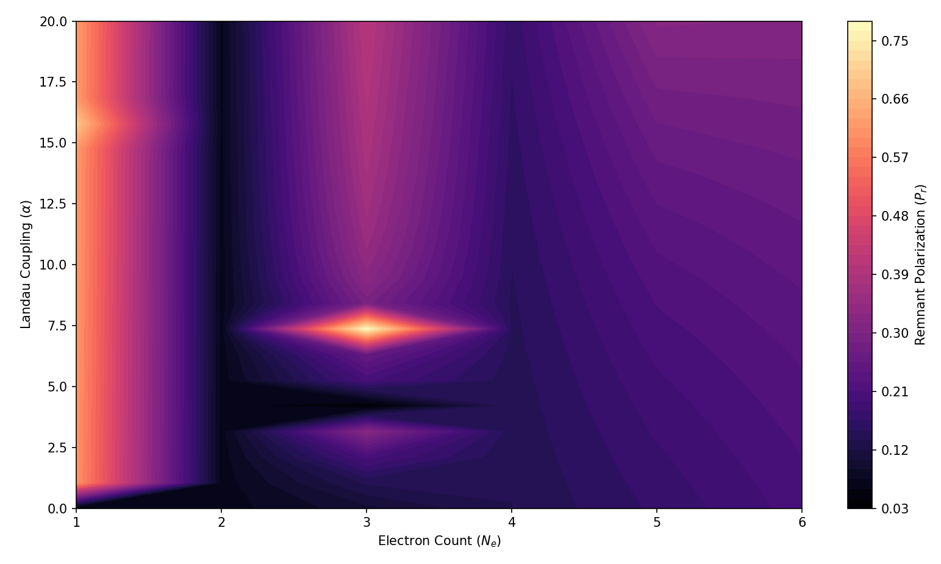
Developed a localized 1D self-consistent field (SCF) solver in Python to simulate the suppression of ferroelectric hysteresis by metallic screening. Implemented a highly optimized tridiagonal eigenvalue solver and Anderson mixing algorithms to solve coupled Schrödinger and Poisson equations.
View Source Code on GitHub
Drag the slider to increase the charge carrier density (N_e) and observe the collapse of the ferroelectric hysteresis loop. Note the collapse of hysteresis when the density is 2, as the electron shell fills.
Instrumentation & Hardware | Arduino & SolidWorks
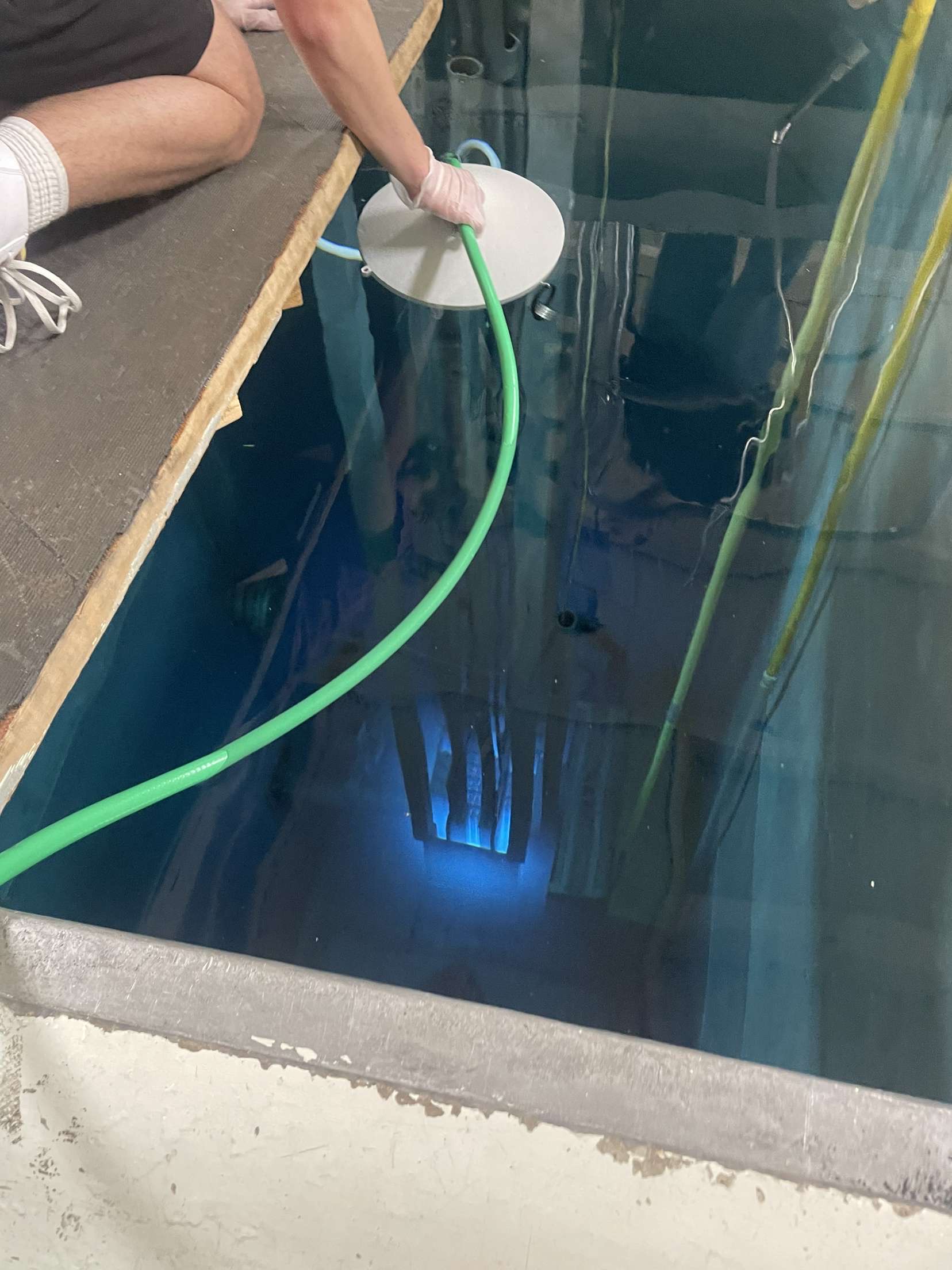
Designed and managed the construction of an airtight, submersible detector to characterize the luminous intensity of a nuclear fission reactor pool. Wrote Arduino scripts to capture and log memory outputs, allowing for precise calculations to estimate the operational efficiency and wattage of the reactor based on theoretical luminosity models.
View my full academic and professional background, including advanced coursework, fabrication skills, and research history.